
Getting to Know Marty Lanser
Marty has a degree in Communication from Washington State University, where he was a mighty Cougar. He began his career in radio at KUGR as a DJ and program director and later, fun fact, worked at KWSU as the last morning disc jockey before the station went totally NPR! His career eventually led him to Modesto, where he became a longtime radio show host at KO93. Marty can recall stories and facts about radio history with remarkable ease. Ask him about baseball, and be prepared—he and his wife, Terry, are major fans who love listening to baseball games together. As I listened to Marty, I was impressed by his incredible memory for statistics and the history of America’s beloved game, as well as his knowledge of radio history. His enthusiasm is contagious, and his stories are as engaging as they are fascinating.
Marty has been blind since birth, but blindness has never kept him from pursuing a full and meaningful life. His career has taken him throughout the West Coast, working in radio in Oregon, Washington, and Idaho before bringing him to Modesto in 1989. It was in Oregon that he met Terry, who would become his wife, and eventually the two made their way to California, where Marty began his long career at KO93.
Reflecting on his life, Marty puts it simply:
“My blindness really— I mean, I had to work around it and I had to overcome it, but I was used to it. It was just part of the deal.”
That perspective says a lot about Marty. He doesn't deny that blindness has presented challenges, but he also doesn't see it as something that should keep him from doing what he loves. For Marty, it has simply been one part of the reality of his life— and there has always been a whole lot more to that life.
So, welcome to Marty’s story: a story of radio, baseball, perseverance, and a snappy sense of humor.
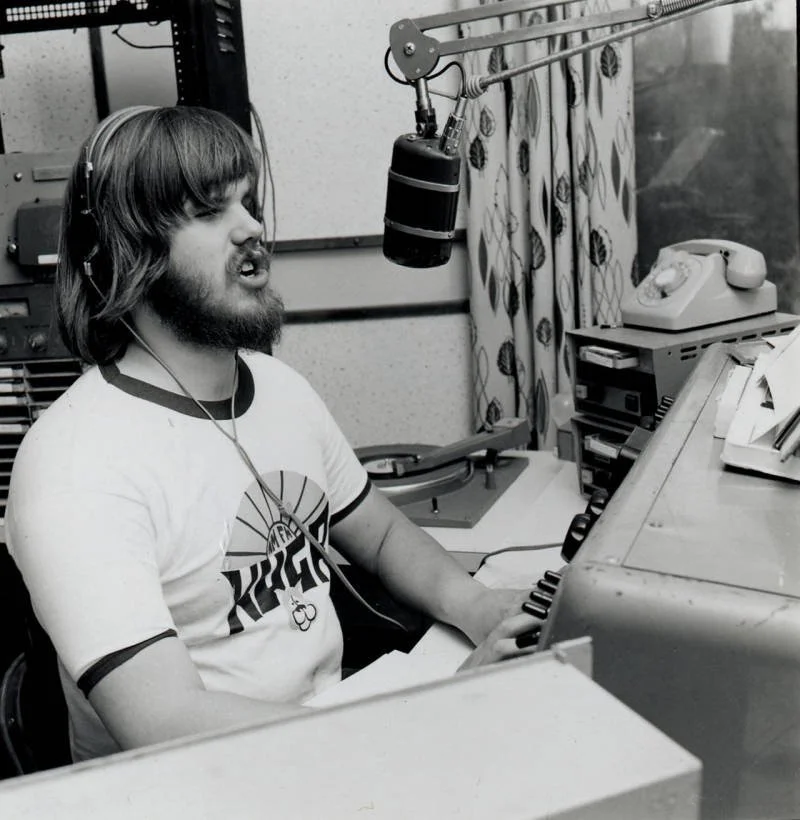
Marty Lanser, Washington State University, 1977.
Image Source: https://content.libraries.wsu.edu/digital/collection/p16866coll20/id/38693/
Roberta: Marty Lanser, tell me a little bit about yourself. What would you want people in the VIPS community to know about you?
Marty: Well, I guess I'll start when I was born in 1954, 72 years ago, and I weighed three pounds when I was born because I was premature. And they put me in an incubator to give me oxygen, and what happened was I got too much oxygen, so that created scar tissue on the retinas of my eyes. When I came home from the hospital, finally, after two months, I was basically blind. I had a little bit of light perception, but that's it. It was not what I would call real functional vision. But, you know, because I grew up with it, it was not a big deal… I mean, it kind of was sometimes, but you know, you just worked around it and through it and you got– you know– over it.
And I was encouraged– our family was pretty social so you know, I had I guess a lot of friends we did things with, and so I always liked being around people. And, when I started school, I went to school not at a state school for the blind, but a program in Seattle schools that had a blind resource program and so we all went to one school, but it was a regular school. And as we got older we were in regular classes more… and I developed a real interest in radio— being on the radio, playing the hits.
Marty has a wonderful sense of humor, something that came through throughout our conversation. He has a knack for telling a story with just the right amount of mischief, and he clearly knows how to land a punchline! When he talked about choosing Washington State University, for example, Marty was quick to point out that his decision had absolutely nothing to do with a certain survey that had recently been published:
Marty: I liked the music and that's what I wanted to do, so I looked at colleges in my senior year of high school. I went and visited Washington State University and said, “Yeah! I like this place!” You know, and I don't think it had anything to do with a survey that came out not long before I went there that rated the top 10 drinking schools in the country.
And they were really surprised because Washington State and Idaho— University of Idaho, which was just eight miles away— weren't in there. And somebody goes, ‘What about that? Your survey is flawed!’ And they said, ‘Well, we don't count professionals in our survey.’ So it didn't have anything to do with that.
What really excited Marty about Washington State University was the opportunity to get behind a microphone. The campus had two radio stations, and Marty quickly discovered that he wouldn’t have to wait until he had finished two years of classes to get started. If he could demonstrate that he was good enough, he could begin working in radio right away. That opportunity was exactly what he had been looking for. While earning his degree in Communications from 1972 to 1977, Marty worked at both of the university’s radio stations—KWSU, a 5,000-watt station that is still on the air today, and KUGR, the campus station. At the time, KUGR was broadcast through the local cable system, meaning students and community members could tune in through their cable connection. Listening to Marty describe those early radio days, it was easy to hear how much he loved being on the air and how excited he was to find a path that combined his love of music, communication, and radio.
Marty: And I got out of college and finding a job was tough– and I got really at times discouraged because you know it was the same old thing, and everybody has to deal with this to a point. “Well, what kind of experience do you have?” Well, I don't have any but how am I going to get some if you don't give me some?
Roberta: Exactly.
Marty: And nobody at first wanted to give me some, and it turned out there was a guy that I'd known in college– it was his last year, my first year– and he’d bought into a radio station in Wenatchee, Washington, and was running it. He said, "Hey, we might have a place for you here." So I got a job there and worked there for about a year.
And, I got distracted with the Amway sales and marketing plan, and so I left. And when I realized that the Amway sales and marketing plan wasn't made for me, I had to reenter radio, but in a smaller place. So, from 1972 to 1986– or 1977, I mean, to 1986– I worked all over the place on the West Coast. I worked in Oregon, Washington, and Idaho. And then in 1986– that's right, I got a job in Oregon– that's where I met Terry. We got married, and we moved here to Modesto in 1989, where I went to work for a station called KO93. And by the time you were, you know, coming up, it was B-93 then.
Roberta: B93.1, yeah.
Marty: And it was KO93. We were pretty much direct competitors with Sunny 102 or K5 FM… Matter of fact, we moved here so I could do all nights. And they even paid for half our move, which they would not do now– matter of fact, there are very few all night disc jockeys now that are live and local, it just doesn't exist. The industry has changed so much, and I don't like what it's become, but you know, what can I do about it? But I’ve been in Modesto here since 1989.
Roberta: What was your education like as a kid? Did they teach you Braille?
Marty: Yes. Yeah, we learned Braille in the first grade. And I can still remember it, with the big Braille writers. G space, C space, C space, and the bell ring and you hit the advance button and move the carriage over, D space, D space. Oh, I remember that.
Roberta: Were those drills you had to do?
Marty: Yeah, kind of. I mean– I don't know if they came out of a book, but that's what the teacher would do. We learned it, and we immersed ourselves in it. And that's the problem now. I think somebody came up with the idea, and maybe in one respect it sounds good, but they came up with the idea that, hey, these kids ought to be going to their neighborhood school so they can, you know, go to school with their peers right in their neighborhood. Well. Sounds okay, except how are you going to get proper Braille instruction for kids all over the city? What you're going to do is– and what they did was– they said, yeah, you get maybe Braille two hours a day for three days a week, as opposed to every day, all day, at first. But I think they've done a real disservice to the students by doing it that way, as opposed to how we did it where, no, we didn't get to go to school in our neighborhood, and that was kind of a bummer sometimes, but we got a realgood education.
Getting to school was a little different for Marty. From kindergarten through fifth grade, he rode to school in a taxi— a childhood experience he remembers fondly, even wishing they had kept the taxis around a little longer:
“Kindergarten through fifth grade it was a taxi and then they went to these Ford Econoline vans when I started sixth grade, and that meant there were more kids. But yeah the taxis were really cool!”
Marty remembers that his school had approximately 500 students, but only 10 or 11 of them, including Marty, were blind or visually impaired. The students had their own classroom where they could receive specialized instruction and support, and as he got older, more of his day shifted into the regular classroom, while the specialized classroom remained a place where he could get additional support when he needed it. Marty remembers that some students had a more difficult time navigating school than he did, but he credits his outgoing personality for helping him connect with others.
“I was pretty outgoing, and kids seem to like me,” he told me with a laugh. “I don’t know why.”
Roberta: Do you use Braille often today?
Marty: No, because I can't get my hand up to read it. I can't raise my arms hardly at all and so, no, I don't use Braille anymore. And I miss it, but you know– just the way it is.
Roberta: So what tools do you use now to consume media?
Marty: Well, I use this little round ball over here. We don't call her Alexa, we call her something else. But– and I won't say what we call her because then she'll wake up– I use that a lot for listening to– I guess, the way I spend my time now since the ALS is– you know, I can't move around real well on my own because my balance is so affected, because my head wants to flop like this, and my back is weaker. And so my legs are okay, but I get real tired, so I'm not walking around much. I'm pretty much in this chair all day except to get up and, you know, go down to the restroom or something. I'm in this chair pretty much all day.
But for my birthday, I got Sirius XM from my wife here. And I listen to a lot of baseball.
Terry: A lot of baseball. The only good thing is I made him a Yankee fan. And now he listens to the Yankees with me.
Marty: You're not going to remember this, because you were born in 1985. In the 60s, you know, we got baseball only a couple times a week, and it was the game that NBC or CBS gave you, and you had no say. I mean, so on the West Coast, we got a lot of Dodgers, a lot of Yankees. You know, the teams were good, and we got to watch them. That's how Terry remembers being a Yankee fan, because she was in Oregon, and he used to watch the Yankees either on Channel 6, CBS, or Channel 8, NBC.
So yeah… you know, we watch TV when the shows are good, and again, we've got a nice remote for DISH. I like DISH because it talks to you and tells you where you are, and if you want to record a show. But again, it's getting harder and harder to push those buttons. But DISH is very blind friendly, that's why we frankly still have it, because I can operate it.
Roberta: Throughout your life, did you find that the advancement in technology was easy to follow? Like if there was a new development, whether it's the computer or the phone or different accessibility tools? Did you find that you were able to learn them quickly, or did you choose things that worked best for you and then stick with those?
Marty: I think that's the latter– yeah, I chose things that work the best for me. And you know now it's getting more tricky because my hands are just becoming less useful, and so yeah, the things that worked for so long you know aren't working as well now.
I mean, I remember in the late 90s– like 1996 or 7– radio you know started going more technological with– instead of having CDs and records and tapes– everything was on the computer. And, I thought, “Man I guess I got to learn this stuff. I really don't want to but I guess do the best I can.”And what I found was– at least at our place– they didn't know how to adapt the stuff to work for me, so I needed some sighted help to do my job. Terry and I worked together, you know, and she was my helper. And they paid her to do that. I was on social security disability and I could make a certain amount and Terry made whatever was left– which usually was more! But that's how we accomplished it there, because they just didn't know how to do it– in other words, they weren't willing to adapt the equipment, but they were willing to bring somebody else in.
Roberta: I wonder what that experience is like for other people who are low vision or blind. Is the workforce generally open to providing accessibility tools, resources, and accommodations? I can imagine that it can be quite difficult for some people.
Marty: Yep. When I was coming up, like college, the statistic was, well, about 20% of blind people are employed. And I don't know what it is now. I think it's about the same. But I think, I mean– and I don't like to be a pessimist– but I think it's going to get worse. Because now... you know, its speed– we want you to be able to work fast.
Roberta: Yes.
Marty: And, I had a friend that worked for the U.S. Naval Shipyard in Bremerton in Washington, and he was partially sighted. And he worked there for a long time. As a matter of fact, he got retirement and everything. But he said, I left finally because I realized, you know, I was just too slow. I couldn't do it. And I think that's going to be a factor– at least in some jobs.
When I was 18 and 19, during the summer in Seattle, I worked at a Sheltered Workshop called Lighthouse for the Blind. And, you know, I hated it– I was going to college, so I wouldn't have to work there. But I thought, man, I'm going to lose it. Anyway, but I applaud those places now, and they're closing down because.The good old National Federation of the Blind, among others, have put pressure on them about what they pay their workers.
And I understand the concept, but if you're not able to do the work to the level that– I don't know who gauges how much you should be able to do to get paid X amount of dollars– but you know, would you rather make, say, $10 an hour and work and feel like you're accomplishing something and make a little money and have a little bit extra? Or would you rather– and this is what happened with Production Unlimited here– where developmentally disabled people were, they shut down, far as I know. And now those people, oh they go to these day programs, and you know, for some of them it's a waste of time! But they got shut down, and the Lighthouses, I hear, are gonna get shut down too.
Roberta: There's not a lot of federal funding right now, which is what VIPS is experiencing as well– speaking of! You told me a little bit about your childhood and where you grew up and how you came to Modesto. How did you get involved with VIPS?
Marty: Well, I heard about it. I think somebody asked me to speak one time. I guess it was like a gala way back in 2005 or 2006– I met Mauricio and I guess… my sort of thought was, “hey you know what? I want to pass on what I've learned, if I can, so that it's a little easier for the next person.”And what people don't understand is that, if you’ve been blind since like me– well, basically since birth. You know, your perception is one way. If you lose your sight, like at age 55, we'll say, it's totally different for you. You're having to learn things now all over again that you learned as a kid. But you've got to learn different ways to do it, and it's hard. Some people, frankly, adjust better than others.
Roberta: Yea, very different. I'm learning that– through the clients that come through the door– their experience with vision loss is– and everyone's– is so different. The emotional experience, the physical experience– every person is unique.
Marty: Yep, that's right.
Roberta: Is there any advice or... something you would want to share with clients who are older experiencing vision loss for the first time? As somebody who was blind basically since birth, is there any piece of information you can give them to help them along their journey?
“I think I would say get plugged into a group. I think we have a really good support group here.”
Roberta: What would you say has been the most challenging part of being blind for such a long time? What has that experience been like for you?
Marty: I would say probably the technological challenge– dealing with technology
Roberta: Because it changes so fast?
Marty: Yep. Now when you call a business or a doctor's office you get AI, and you can't really talk to somebody easily.
Roberta: It's frustrating even for a sighted person!
Marty: I know! And this stuff's been crammed down our throat. And I resent it– I really resent it. Because it's 25 year olds doing it who understand this stuff, and they think everybody can– that's not true! Yeah… don't get me started on corporate America!
Roberta: Hahaha! We can talk about that later!
One of the things that makes Marty so easy to talk to is his laugh. There’s a warmth and friendliness in the way he tells his stories– even when he’s griping on the woes of corporate America– there’s often a laugh woven into his words. That warmth came through again when I asked him what he would want a sighted person to understand about vision loss— what he would want someone to take away after hearing his story.
His answer was simple: don’t be afraid to approach someone who is blind.
“It’s okay to approach us, ask if we need help. And if the answer is no? Don’t take it personally. It’s okay.”
Marty knows that independence looks different for everyone. Some people, he said, are determined to do things entirely on their own, regardless of how long it takes or how it looks. Others, like Marty, are perfectly happy to accept a helping hand when it makes sense. “Yeah, I could use your help. I could stand getting there faster,” he joked.
For Marty, the important thing is simply not to be afraid to make the offer. A person who is blind might say no, and that’s okay. Respect their answer, let them continue on their way, and don’t feel bad about asking. Or they might say yes. And maybe, as Marty pointed out with his characteristic warmth, “you made a friend.”
Roberta: Like, if I saw you in the grocery store, and maybe whoever was with you helping you was in a different aisle, how would I approach you, if I didn't know you?
Marty: I think you could just come up and say, “Hi my name is Roberta, and I see you're shopping here, and I see the person that helped you is another aisle. Is there anything that I can help you with?” It’s that simple.
Marty also understands why some blind people may be hesitant when a stranger offers help. For someone who has worked hard to maintain their independence, accepting— or even appearing to need— help can feel complicated. There can be a sense that if you don’t demonstrate that you can do something on your own, someone might take away a little piece of the freedom you’ve worked so hard to maintain.
But there’s another side to that interaction, Marty pointed out: help should always be offered, never assumed.
He recalled how people will sometimes walk up to a blind person in public, grab them, and start moving them without ever saying who they are or what they’re trying to do. “If you live in San Francisco, you’re thinking, somebody’s going to mug me,” Marty said, recalling a friend who experienced something similar and reacted instinctively by accidentally punching his friend in the face when someone grabbed him while trying to help.
Marty laughed. It’s funny to recall, but this simple courtesy is an important one: before stepping in, introduce yourself, ask if help is needed, and respect the answer. In a world that often moves at an exhausting pace— with people rushing down sidewalks, through grocery stores, and everywhere in between— it can be easy to forget to slow down and consider someone else’s experience. And for a blind person, being perceived as “in the way” shouldn’t mean someone has the right to simply move them out of it.
Roberta: When you were a kid, was there ever a moment where you thought, I can't do this or I can't do that? But then you learned you could do it, maybe, but in a different way.
Marty: Oh, yeah. I don't have a lot of patience. As a kid, I can remember telling my mom: I can't do that! Like buttoning my shirt or cutting a piece of meat. I can't do this! And we just worked on it until I could do it. And one of the things that's helpful about going to school with some other blind people is that, you know, they were going through some of the same stuff. And– you know– there was a really annoying kid named Stuart that was in the blind program, and I got to saying, “Man if Stuart can do it, I can.” And I'd see what he was accomplishing, and go, “okay i don't have any excuse. If Stuart could do it, I guess I better do it!”
Roberta: I think that's a great reminder about what you said about the importance of support groups and community– is that surrounding yourself with people who are similar to you, but experience vision loss and blindness differently, and you can all share your experiences and how you're overcoming challenges.
Marty: Yes. Yeah. That's right. This group [Modesto Support Group] has always been pretty good. We don't, you know, get up and go, “oh what's wrong you can't take BART by yourself, what's the problem?” In our group, you're not going to get that– you're going to get, “Hey, this is what I did when I took BART, maybe you can try this.” But our group has always been good, and continues to be as long as i have something to do with it!
Roberta: Well, we're very lucky to have you, Marty. How long have you been leading the modesto support group?
Marty: About three years. Well, I started going to the support group, like, back in 2008 or 9. But I wasn't leading it. I would lead once in a while if somebody was sick– if Janet was sick or on vacation or something. And then Tim got it. And then when he left– when his wife left– he felt, and probably rightfully so, “I think I better stick with my wife.” And so he's not been around a lot. Well, they did come to lunch one time for our Christmas lunch in 2024. Yeah, that's right.
Roberta: Were there other VIP services that you participated in in your time?
Marty: Yeah, I did computer training, and I did independent learning skills– believe it or not, back in 2013 I tried to work at VIPS because the radio career kind of flattened out and I was getting older and I knew it. And so they taught an adjustment to blindness class and I was the teacher for six weeks. But it was one of those things. We didn't really have a full-blown executive director then.
Roberta: Well, we were just talking about bringing that class back.
Marty: Well, I think that's good. I mean, there was nothing wrong with the curriculum of the class.
When I asked Marty what he would say to people who might be interested in supporting the work VIPS does— whether through financial contributions, volunteering, or simply giving their time— his answer came quickly:
“Come to a support group. Meet the people. Listen to them.”
He encouraged people to come even just once, because getting to know the people behind an organization can change the way you understand its mission.
“Your perception of what you think of a blind person may be a whole lot different than the truth.”
That may have been my biggest takeaway from our conversation— and, in many ways, from my experience overall working at VIPS: treat people like humans, regardless of whether they are blind or sighted. Marty agreed. “We are human,” he said. “Just because you can’t operate a computer as fast as this guy over here doesn’t make you less than human.”
And then Terry, Marty’s wife, offered one final thought that brought the conversation full circle. There can be unexpected gifts in experiencing the world without sight, she pointed out:
“You never judge people by the way they look because you can’t see them. You judge them by what they say and what they do.”
It was a fitting way to end our conversation— a reminder that, beneath all the assumptions we may carry about blindness, what matters most is the person standing in front of us.
This interview with Marty was conducted by Roberta Inscho at his home in Modesto, CA on Wednesday, August 26, 2026
