
Getting to Know VIPS Board Member, Mary Grace Cangemi
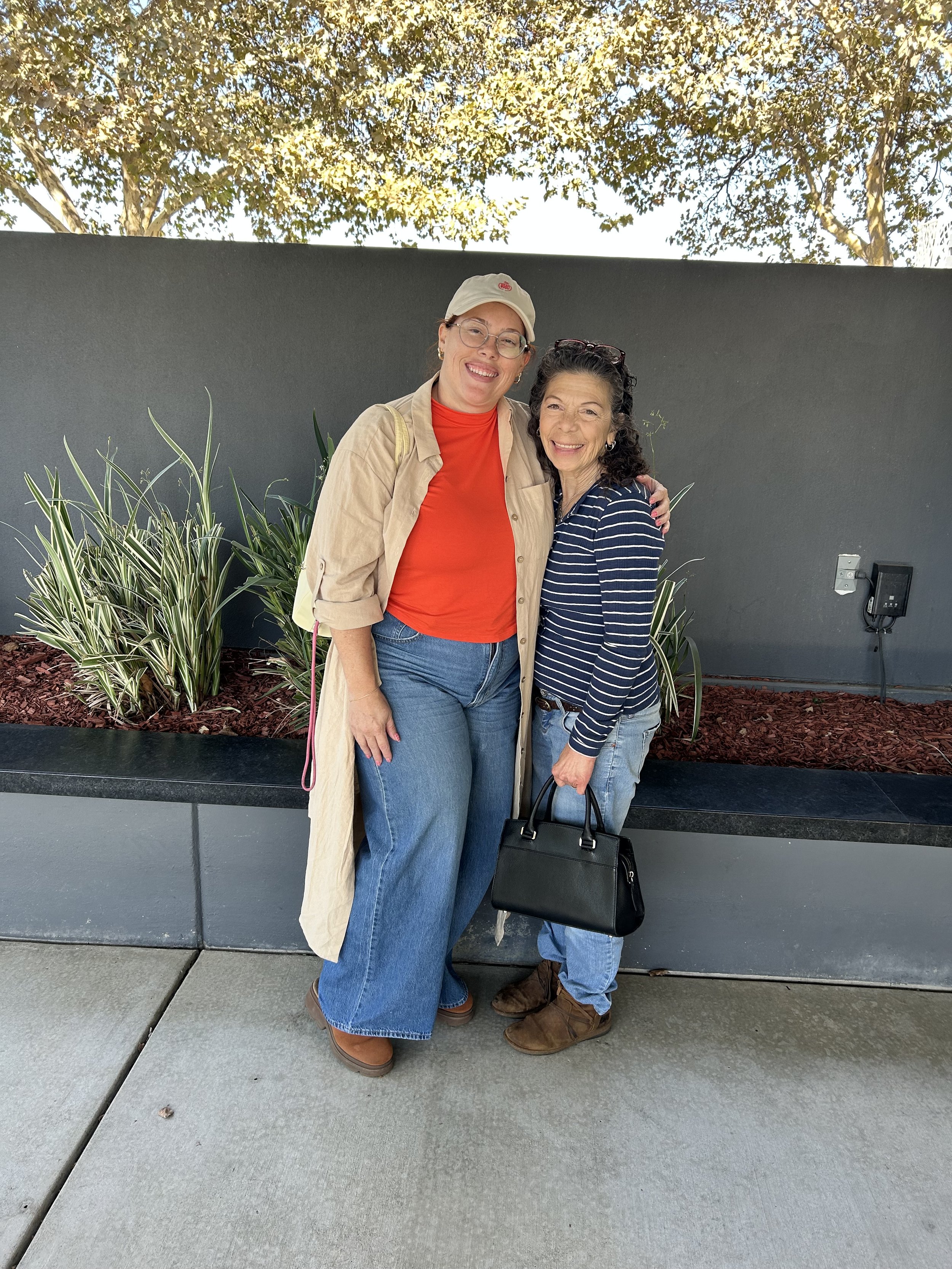
Alt text: VIPS Executive Director, Roberta Inscho, and Mary Grace Cangemi stand close together smiling for a photo with their arms around each other. On the left is Roberta, wearing a beige cap and long beige jacket over a bright orange shirt and blue jeans. On the right, Mary Grace wears a navy-and-white striped shirt and blight blue jeans and carries a black handbag.
Sitting across from Mary Grace at Wildfire in Modesto— her favorite restaurant, in part because the lighting at certain tables works just right for her vision needs— I am quickly reminded how much of a people-person she is. Warm, gregarious, and wonderfully talkative, she opened our interview with, “I’m not very good at talking about myself.” That may be the one area where Mary Grace lacks self-awareness, because she tells an incredibly captivating story about her life.
Born in Staten Island in 1961, Mary Grace recalls that awareness of hearing and vision loss was limited. Mary Grace herself wasn’t diagnosed with hearing loss until she was eight years old. Until then, school was a confusing and often humiliating experience, particularly at Catholic school, where she struggled to understand what was happening around her.
“At that time, we didn’t know that I had any vision loss. And they didn’t realize I was deaf until I was eight. I went to school– Catholic School– and got in a lot of trouble because I never knew where we were. I know– I think it’s called a dunce cap– but I’ve worn that a few times. Nuns were not always forgiving. The second grade nun was not.”
In those days, her teachers labeled her “retarded” and told her parents she should be placed in an institution. Thankfully, her parents believed there had to be something more for their daughter. Mary Grace’s early years were marked by challenges no child should have to endure, but today, sitting across from her, you would have no clue. Despite being nonverbal throughout her formative years growing up, Mary Grace loves to talk, connect with others, and share her experiences— and once she starts telling her story, you quickly realize just how much there is to hear.
Mary Grace: They took me to public school because my parents believed that there's got to be something. They didn't want to put me in an institution. From the story my mom said, I wasn't even there [at school] for like a half hour, and they received a phone call from the teacher at the time saying that, “did you know your daughter's deaf?” And so at that time, they felt really bad.
I had no phonics or any of that kind of stuff. I lost all that. You know, that's when you're being... Your foundation's being poured, so to speak. My parents were hard workers. My dad was, and my mom would stay at home. So I only was able to get one hearing aid.
“I remember the first thing I heard were wind chimes. I have a love for wind chimes and birds. Because I heard something I didn’t know what it was, and they were saying the birds were chirping.”
Roberta: And where was this? In New York?
Mary Grace: In Staten Island, New York, yes. I went to PS 30 in Staten Island, the town is Westerleigh. A really nice place. I was not very easy to handle when I found out I was deaf. I'm not embarrassed about saying this. I was eight years old and I used to lay in the street. I was hoping to get run over. So my little eight-year-old friend used to have to run home and tell my parents that I was in the street trying to get hit by a bus or something. No one was talking. No one was telling me anything. There was no, “this is okay, you know, we'll get you through this.” It was just, okay, you’re wearing a hearing aid– here you go!
Roberta: What kind of assessments or what did the school– how did the school know?
Mary Grace: I was reading her lips. She knew. She told my mother because I was staring at her. I was just staring at her and didn't, like, I didn't move. So she realized– she must have been educated or knew about this. Because how else would you know I'm reading her lips? That's how I got by. Eight years of just reading lips.
Roberta: Wow.
Mary Grace: And I’m a really good guesser. That's what I've been told by audiologists. That I'm a really good guesser. And still today, I still pause. And I'm, like, trying to figure out if I got the whole content correctly, instead of just saying, “can you repeat yourself?” I’m always trying to be that person that doesn't have to ask again.
The bullying came soon after that, which didn't make it easier. There was a young boy. I used to walk home from school. The young boy called me over. I knew him from just playing like kick ball– the summers were great growing up– but he wanted to show me something, and I looked, and he sprayed spray paint in both my eyes, so I was devastated. I was eight years old. This is all happening at eight. But I had to try to figure out my way home because I couldn't see– screaming and crying all the way home. But I was in the neighborhood, so people knew me, so I was able to get home. I couldn't tell you what happened after. I suppressed a lot.
In those days, being deaf, you were freak– at least where I was. So you were labeled. Third grade, I was following the teacher around the classroom, and my parents still didn't know what to do. They were clueless. But anyway, I was following the teacher around the classroom like this [MG demonstrates using the desks as a guide with her hand), and the desks were attached to each other. And the next thing I know I got stabbed. The kid stabbed me with a pencil. through my hand, right through it. And, you know, told me I was a freak, you know, and don’t touch his desk.
So I didn't want to go back to school after that. You know, I was petrified. Afraid of my own shadow. And scared of everything after that, because people were not my friends, you know, people were enemies, the world was an enemy suddenly.
I think before I knew I was deaf, I was in my own world, and I don't know about other individuals, but I have a feeling those who are close to my age will realize that you isolate a lot. I still do, even as an adult. I will isolate because their surroundings are not familiar or they seem threatening. My parents did the best they could, and I love them for that, you know. But as I got older and realized there was so much more that could have been done. I could have went to Fremont School for the Deaf or the other deaf schools that were out there, but they didn't know.
And that's okay, because my mother got this beautiful individual who came to my house every day that taught me to speak– at 13 years to speak– and I know I still talk funny. I don't hear it, but other people do. And I just blame it on New York. Because the way we say "soda," and then I'm like, "I'm from New York." I don't blame it on my ears.
Roberta: So at 13 is when you learned speech?
Mary Grace: Yeah! She started coming at 10, and it took until I was almost 13 years. All the way until I got married. She started coming at eight, well, at nine, early on– I still can't distinguish between an S-H and a C-H.
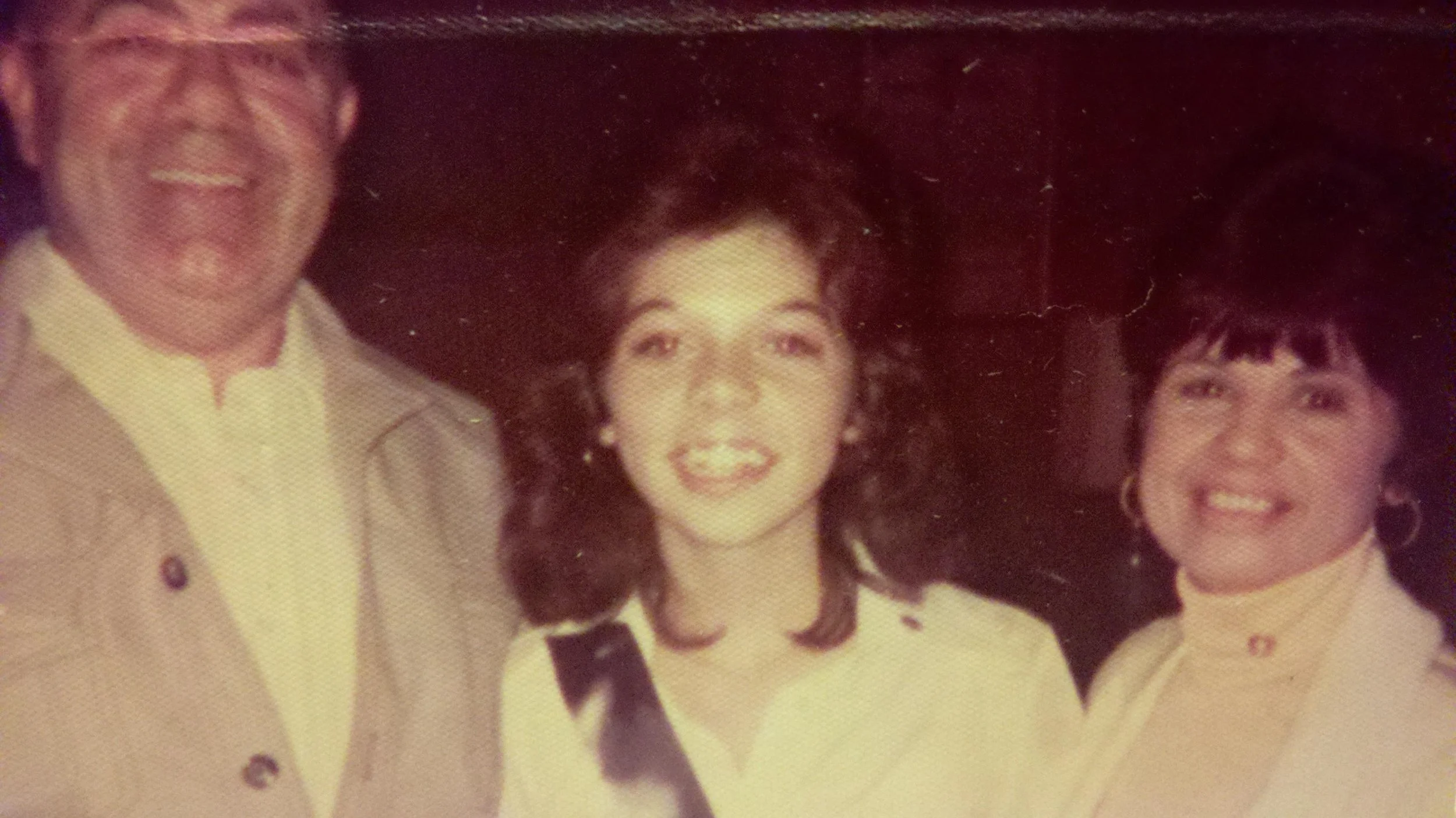
Mary Grace, age 12, with both her parents.
For Mary Grace, learning to embrace herself wasn’t a single moment of realization, but a journey that came in spurts, with more challenges along the way. One of the most painful chapters was her first marriage in 1980, when she was just 19, which she describes as deeply abusive. While raising her three beautiful daughters, she struggled to find a way out of a relationship that left her feeling broken and emotionally numb. But Mary Grace eventually found the strength to leave and continue her education. It was during this vulnerable time, while attending college as a young mother, that she met someone who helped her rediscover her own strength— a person whose kindness and attention reminded her that she mattered, too.
Mary Grace: I was starting to build. Starting to build. I put myself through school. I had people who came out of the woodwork. The backbone just built. I was me. And… I was going to take care of my kids, and it got to the point where if my hearing was a problem, it was theirs– other people's problems– not mine. I was tired of being labeled: “well, you're deaf, you're dumb.” I'm not dumb. I graduated on the honor roll from college. But I had to do that for me. And I wanted my daughters to be proud. Now it's like I want to protect, to be the advocate for those who don't have voices, because I didn't have a voice. Nobody yelled for me, nobody fought for me– but… they did, but I didn't see.
“So I guess that’s what I would want people to know: is the resilience that we have as individuals with disabilities.”
We're faced with– even all the years that I've worked– wanting to go out for, you know, a different position– “Are you sure you can handle it?” Why? I open and close registers. I do merchandising. What are you afraid of? Because I can't hear? So that is– I think that is the key word– it's determination, resilience. There's nothing you can do to put me down anymore– nothing. So you can't hurt me. Your words, none of it.
As people with disabilities, we have to be the ones that have the patience. Because sighted people don't. People who hear, don't. Society doesn't give you that room. So, now, it's almost like I went from this individual who was being suppressed by society, by a husband, because he didn't want anybody to even look at me. I was his. I felt like I was in this cocoon, and I emerged. You know, like, almost with like bionic powers or something.
Roberta: I love that.
Mary Grace: Even when I met my now husband– when I met him, he knew I was deaf right away. He– or his family is deaf. He's the only one that hears. So he's fluent in sign language. So there was instant connection, because he understood, but he still doesn't understand. And so, my husband even says that I'm unstoppable. I will stop at nothing to make sure things are correct, things are right. That's why I'm tough.
“Even now, as a mother, and as a mother with disabilities– as a mother who had to fight her way through her life– some people have it a lot worse than me, and I know it. I know it. I am never going to say, you know, woe, woe is me. But for what I had, I know now that I can help others overcome things– be the best they can be or whatever they want to do, because the doors are still shutting on individuals like me, you know.”
Mary Grace is a woman who believes in luck, or perhaps, that some things happen for a reason. When I picked her up for our interview, it was 11:02 a.m., and she immediately lit up. “11:02! That’s my birthday. A lot of things happen for me at 11:02. Do you ever notice that?” It was a fitting introduction to a woman who seems to find meaning in the unexpected twists and turns of life.
After leaving her first, abusive marriage, Mary Grace moved to South Carolina, where she enrolled in a technical college to study early childhood education. She found work at a preschool that welcomed her and her young daughters, and she found something just as important: a friend named Barbara Gazelle.
The two women became each other’s lifelines, trading childcare and helping one another navigate the demands of raising young children while working and going to school. Mary Grace still speaks of Barbara with deep affection and gratitude.
“She worked nights in a hotel. I had her as a kid sleep at my house. And then when there was time for me to go to school, she would take care of mine. And then I'd get home– her kids were in school already, mine weren't– I would take my kids, and I would go get her kids. We balanced each other. God bless her.”
They eventually lost touch when Barbara moved to Florida, but their story took an extraordinary turn years later. Before they parted ways, Mary Grace had asked Barbara to look after a piece of furniture that had belonged to her grandfather—a small, antique grandfather’s closet from the 1800s. When a hurricane devastated Barbara’s home in Florida, nearly everything was destroyed– except the closet. Mary Grace recalled a phone call where Barbara shared how it stood untouched amid the wreckage. Barbara saw something meaningful in its survival, as though it were a sign from Mary Grace’s grandfather, and asked if she could keep it. Mary Grace agreed. The survival of that little closet seems to be one more reminder that even in the midst of devastation, something precious can remain.
Roberta: You said your now husband knows sign language.
Mary Grace: Yes, because he was born in a deaf household.
Roberta: So did you ever learn sign?
Mary Grace: Yes. I'm not fluent. I started going to the Braille Institute in San Diego, remote, and took sign classes– actually, I went to MJC first. 2003. That's where I finished getting school and then I went to MJC for three years to get even some of my BA classes there. They worked with me instead of going all the way to Stan State. They were really good. Barbara Wells was my counselor for the disability, and for the sign language, and I took every class she taught. So I was pretty good for a while, but like everything else–
Roberta: If you don't use it, you lose it.
Mary Grace: Yeah, pretty much. And not all of it, because, like, this is “more.” [She demonstrates the sign for “more.”] We’re teaching the baby, and he’ll try to put his little chubby hands together. [She signs “more.”] There’s a lot I remember. So, like, “toast.” “Toast” is through and then out. [She demonstrates the sign for “toast.”] Yeah. Oh, “egg.” [She signs “egg.”] “Bacon.” [She signs “bacon.”] So, you want a bacon and egg toast. [She signs the entire sentence.] So, these are just little things that I remember.
High school was a turning point for Mary Grace. For the first time, she began to come out of her shell and discover where she fit in. She describes herself as one of the “misfits,” alongside the cheerleaders and the hippie types, but she never let those social lines keep her from making friends. At her all-girls Catholic high school, she found a group of girls who accepted one another and looked out for each other. In fact, Mary Grace remembers that the girls often looked to her for guidance. It was a role she might never have imagined for herself, having spent so many years feeling different and struggling with things that seemed to come naturally to her classmates.
Academically, reading remained a constant challenge. Mary Grace knew she had to work harder than her peers, having missed some of the foundational skills other students had developed. She didn’t always recognize her own abilities, but she kept trying. And little by little, the girl who had once felt like an outsider began to find her voice. High school gave her opportunities to perform in musicals and pageants, step into the spotlight, and discover a confidence she was only beginning to understand. Looking back, she remembers those years as a fantastic time—not because the struggles disappeared, but because she was finally beginning to see what she could do.
“I never thought I was much of anything, but that took time to really realize that. I tried. I worked hard. Because I struggled. I didn’t have the fundamentals everybody else had, especially in reading. I couldn’t read like everybody else could, and that was a constant struggle. But we all took care of each other– very much so. Being that way built a backbone, you know, I started to build a small one.”
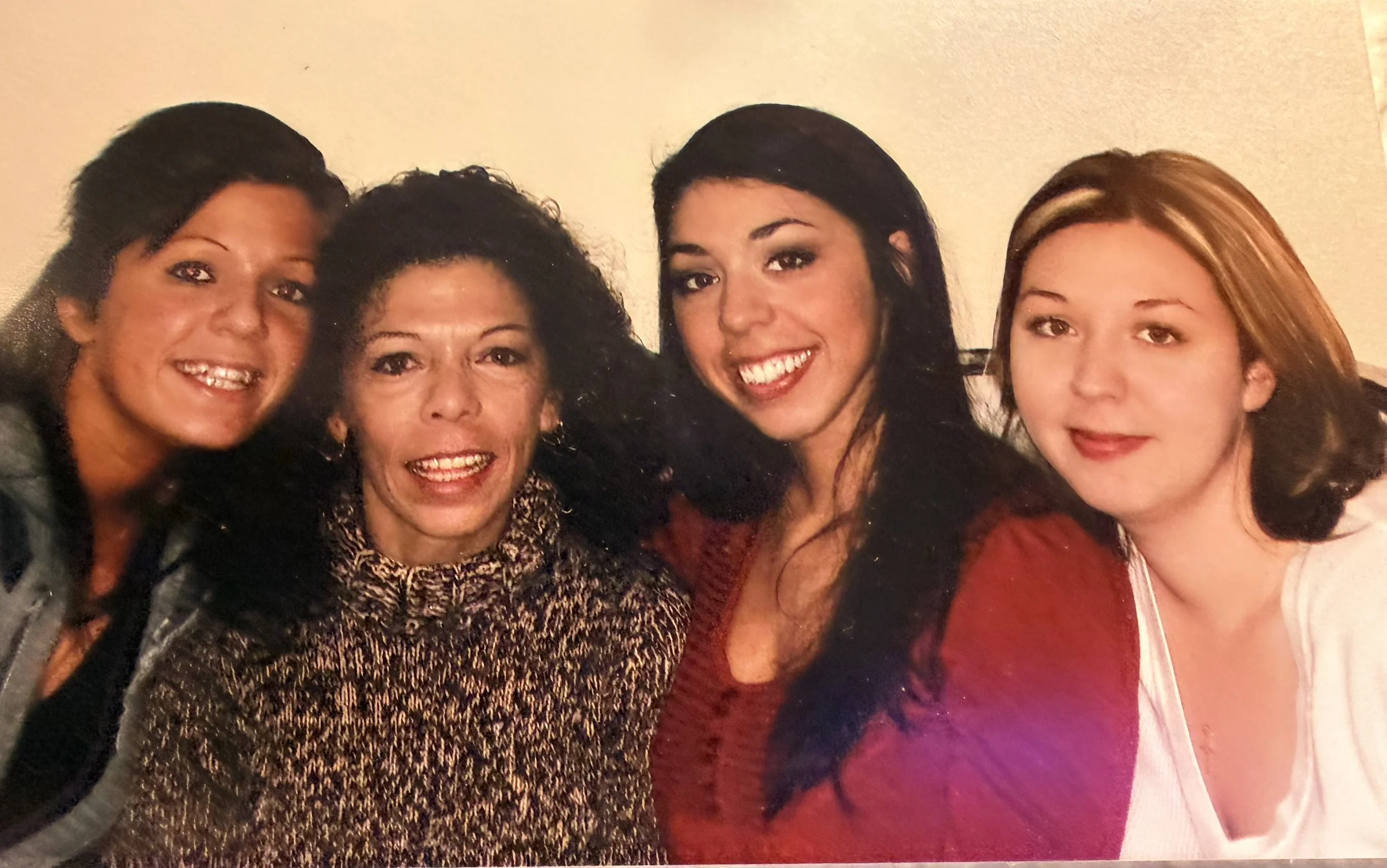
Mary Grace with her beautiful daughters, New York 2006.
Roberta: So when you were in high school, were you the only deaf-blind student?
Mary Grace: Yes. I was mainstream. No one knew what to do with me, which was a good thing. I got by a lot, and actually, I tried out for what they call Seaton Corral– we did musicals at Christmas. And, oh, I loved it. But those things started bringing it out of the shell. Yeah. My father played Santa, and I was his elf, his helper, so... I was constantly putting myself out there, and I needed to. To say, “hey, look at me, this doesn't stop anything, you know.”
Roberta: So you were an adult when you met a fellow DeafBlind person?
Mary Grace: Yes– DeafBlind, yes. Was it… freshman year? I don't remember how it happened. Her name is Jeannie. She was deaf like me. There's also Sal. They were all– Sal had a box (referring to an assistive listening device). And I found this group of kids that would just, like, talk to the side. And I used to invite them in to our party. Like in high school, we used to be able to go to dances. I pulled them in. And so I found out, that's when I knew someone that was similar to me– that was even worse than me. Salvatore was worse. And I used to tell their parents, “let them come.” We were just freshmen, you know. And then we would meet, like, have, like, little parties in the basement. Nobody was drinking, but it was just parties, you know. You could still live and have a blast. Come on. So I think I was starting to come out of my shell differently that way.
And I end up being– I think it was junior year– in high school, you always got a freshman sister. So you take her under your wing and do everything. So Jeannie, came to St. Peter's. So that was the second deaf girl. I was, I guess, a leader. I've always been a leader. My mother said even as a child, I was always leading something, even if it was on my own. But I didn't know that. How much do you know at that point? But that's why I was excited that Jeannie came to school. She went on to college. I didn't really know what happened to her after that, but she was smart. And I used to tell her, “do not let your hearing stop you from anything. If somebody tells you you can't, tell them to get you.”
“I haven’t come across another person like me until now. I have Usher Syndrome.”
Roberta: And when were you diagnosed?
Mary Grace: When I was 50. I'm type 2. Helen Keller's type 1. With people who are type 1 are born– you lose both right away– you're either born that way or soon after. Type 2, you're born profoundly deaf, and then the sight progresses over time, and then you may or may not lose your balance. Type 3, it could be backwards a little bit. It's the hearing that's worse, or the sight that's worse than the hearing.
Roberta: So, can you describe for me what is your vision like?
Mary Grace: Right now, looking at you, I can see your face… but not see your face. I have no peripheral. It's all gone. So, nothing above. Like, I can look at your hand. Right now, looking at your pen in your hand, I see your lip but nothing else. Okay, I see a little bit of your shoulders. So, I'm like in a quarter. A fifty cent p– both eyes together. Like I can see this is a plate, that's my pretzel, salad– but everything, it's almost like there's no color anymore. It's like the pixels are going and everything's muted.
Roberta: So you said you're losing your sight gradually, like over time, right? At what age do you remember having better sight?
Mary Grace: I would say the central vision has always been strong– even my doctor says it's holding even though it's kind of on the blurry side– it's holding on for dear life. I remember seeing my dolls, my records, my animals. I wanted to be a vet back in those days– or a jockey.
Roberta: A horse jockey? I love that.
Mary Grace: Yeah, I rode horses– bare back– when I was a little, little girl. My father was very much into that, like I was.
Roberta: In New York?
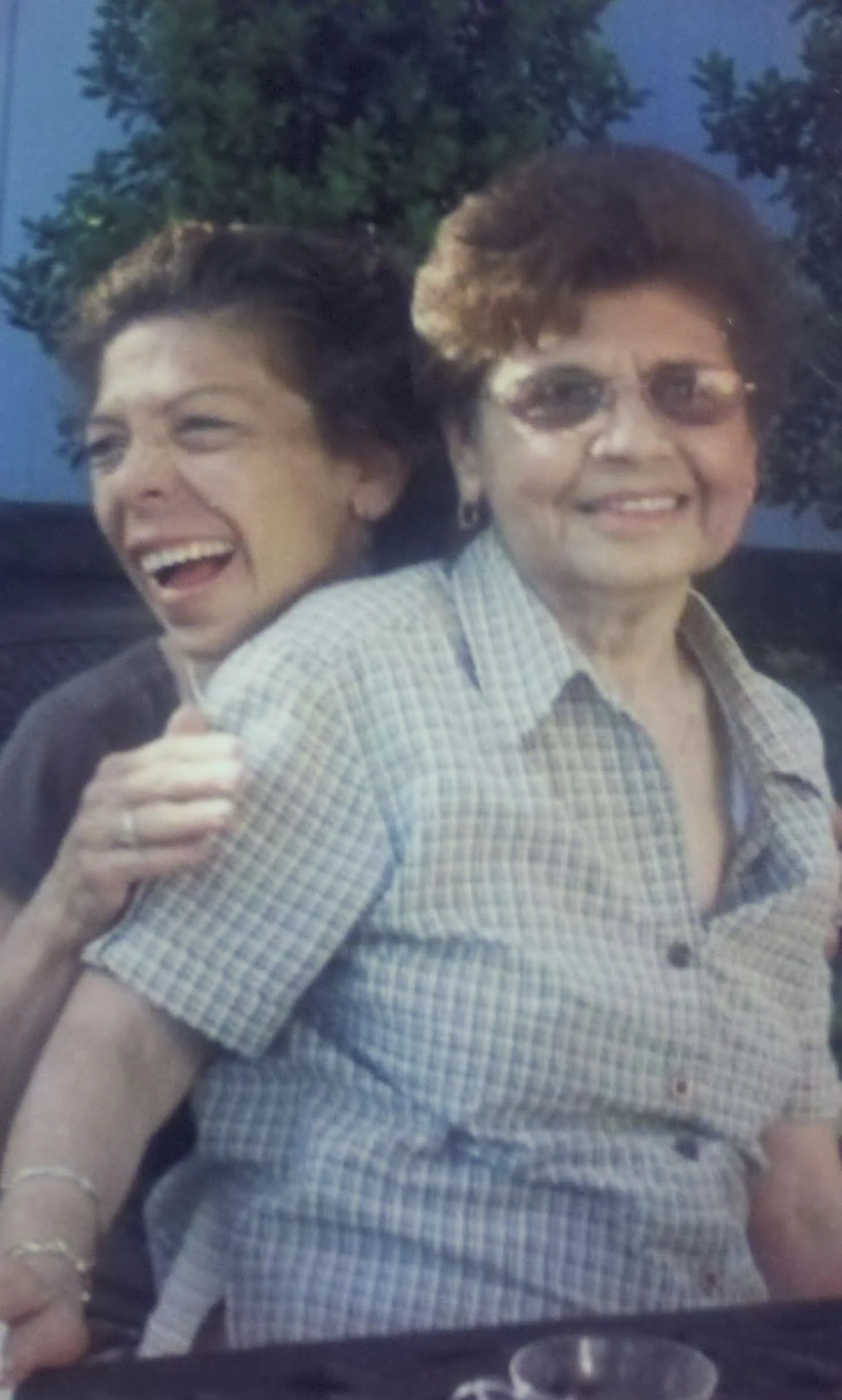
Image Alt Text: Mary Grace and her mother, her best friend. Mary Grace is on the left leaning slightly behind her mother, laughing while looking away from the camera. Her mother is on the right, wearing glasses and a light plaid shirt and smiles at the camera.
Mary Grace: Yes. Well he was raised– my father was born on a farm. My mother is like the city girl, and my father is the farmer. And my, So when they met, they came from different sides of the track– that's the way they called it. Not that my grandparents were rich, but they were well off for that time. But yeah, we raced quarter horses. And I’m a lover of water. I loved to swim. From the time I was a baby, he threw me in the pool– with him, of course! I went under the water right away. He wanted no fear– no fear.
Somebody asked me just recently to describe myself in one word. And I said, “well, can it be kind of an extended one word?” They were like, “what do you mean?” I said, “I'm fearless. I'm not afraid.” I felt like, if I look back over my lifetime and what I have survived– for me, it had to be fearless.
Roberta: I feel like I could talk to you all day! I want to steer us back to VIPS. How did you get involved with VIPS? When was that?
Mary Grace: Back in 2019– it had to be 2019. I don't remember how I heard about them, but I went and spoke to… at that time it was Claudia– at that point, I knew about my sight already, but I really wasn't too sure where I was. But she got me a grant. It was a grant, so to say. And I started– I met Mauricio, but there was no technology yet. And I met Debbie Hanson, and we started the braille.
But then COVID hit. And then in March they shut down. So I called Laura at the time, because she was the director, and I said, “I really would like to continue Braille, and I think she [Debbie] would really like to continue to be paid. May I borrow a Braille writer?” I said, I will sign whatever you want me to sign, to say if I broke it, I'll pay for it.
I called Debbie. She was all for it. Where else are we going?! So I said, “can you do Zoom?” I knew nothing about Zoom or anything. And I heard of it. And we were living in Modesto. And, long story short, Debbie and I met like three times a week for three hours– or two hours a day– over Messenger. Oh, my phone was about ready to blow up from heat, you know! But where else were we going to go? I learned Braille. She got paid. And I loved her, and I still love her– God bless her soul.
And then that went on for a while. And then I went through the DOR (Department of Rehabilitation). And I had done the DOR for my hearing back in 2003. I had Michael Brown– he was the head for sight loss. They put me all through MJC. And I got to get my degree. I was so appreciative of that. I was working in Corporate at the time, and that's when I remembered, I said, “well, now I'm going blind, what do I do with this?” So I went back to the DOR, they reopened my case, and then I started working with Mauricio.
“I love VIPS. That’s why even though I have to leave the California area, I will never, ever vacate my seat. Because I will do everything in my power to keep helping. Because it’s time to pay it forward. They helped me a lot.”
Roberta: When were you invited to be on the board?
Mary Grace: I think it's two years now. I was talking to Isaiah, and then I had a meeting with Isaiah and Liz. And I was telling Liz about all these great opportunities to have fundraising. I didn't even know about the gala at that time. But that's how it got started, and then I got on the board, and then I went right on the fundraising committee to learn from Janice. She is top notch.
Roberta: What would you like somebody to know about VIPS? Like if somebody was out there who needed our services, but didn't know about our services what would you want them to know about VIPS?
“I consider VIPS– and this is what I’ve said before to others– we’re a gateway to independence. That’s how I look at it. Because we can offer so much. The OIB (Older Individuals with Blindness) need it just as much as the young ones– even though the young ones have a future ahead– just because we made it to whatever age we are now, doesn’t mean that we don’t count.”
Mary Grace: And I think we need VIPS more so, because we have been so self-efficient for so long, and all of a sudden, you're not– you need to have the tools to not lose your independence. You can't drive. I mean, but that's probably one of the hardest things to get used to, especially if you've been driving 65 years or 50 years.
Because that's what happened to me. I was driving since the age of 19. I went to see this wackadoodle– that's what he was! And he was a random specialist in New York. He told me that my retinas were completely broken apart. My retina is gone. And then he goes, “you have Usher syndrome.” I'm sitting there looking at him like… what is that? He said, “Google it.” I said, “You want me to what?!” And he said, “Google it.” And I said, “you don't know what it is, but you're going to tell me to Google it, and you're going to charge me $300, $400 for your office appointment?” I got up. I walked out, went next door, because my mom had masculine degeneration– the wet– so, she was seeing that specialist. And I went and sat down and I said, “can I become your patient?” So he became my doctor, and he got me to understand, or helped me understand all of it.
But, yeah, it was a shock– so Mom and I were leaving. We were talking after her appointment. And I'm driving home. I had my mother. I drove my mother everywhere. And he comes running out. And he goes, “Do you drive?” And I said, of course I do. He goes, “don't.” So I looked at my mother, I said, “okay, this is literally going to be the blind leading the blind lady.” She wasn't that far away. God was good. Thank God I never hit anybody– never had an accident. Because when you start losing– I still don't know how much you see. I'll never know, because I never did. So, I can't even imagine it. You know, I grew up thinking I saw just like you, and I didn't. How could it not be the hand of God that did that, you know? Because how did I not hit someone? I drove in New York! When I lived in South Carolina, I drove every other weekend to New York– 13 hours driving!
When he [the doctor] told me this, after I dropped my mother off, I got myself home, and I stopped. Because I felt, I've been told not to. The luck will run out. Or– not so much luck– in God's eyes, I was told. Now I know that would be taking a chance. So then I used to take the bus everywhere. Even at 10.30 at night– I worked closing– and then walked all the way home.
As our conversation came to a close, Mary Grace returned to a theme that runs throughout her life: the belief that things happen for a reason. She sees her faith as a guiding presence, but she also believes in the importance of reaching out for help and giving yourself permission to try something new.
“I love Braille. My hope is that Braille becomes a big deal. It’s hard because a lot of people are told people don’t want to learn because they’re afraid, because it’s not easy. It takes practice. Don’t be afraid. Give it a try. It’s fun! That’s it. I want us to reach more people.”
That is, perhaps, the heart of VIPS. Vision loss can leave a person feeling isolated, frightened, and stripped of the independence they spent a lifetime building. But with the right support, new skills, and a community that understands, there are still possibilities to discover. Mary Grace hopes VIPS will continue reaching more people, bringing braille, assistive technology, and connection to those who need it most. Her message is simple: don't be afraid. Give it a try. And sometimes, finding your way forward begins with knowing you don't have to do it alone.
“I think no matter how old, or whatever you are in life, not to be afraid to seek out help when you need it.”
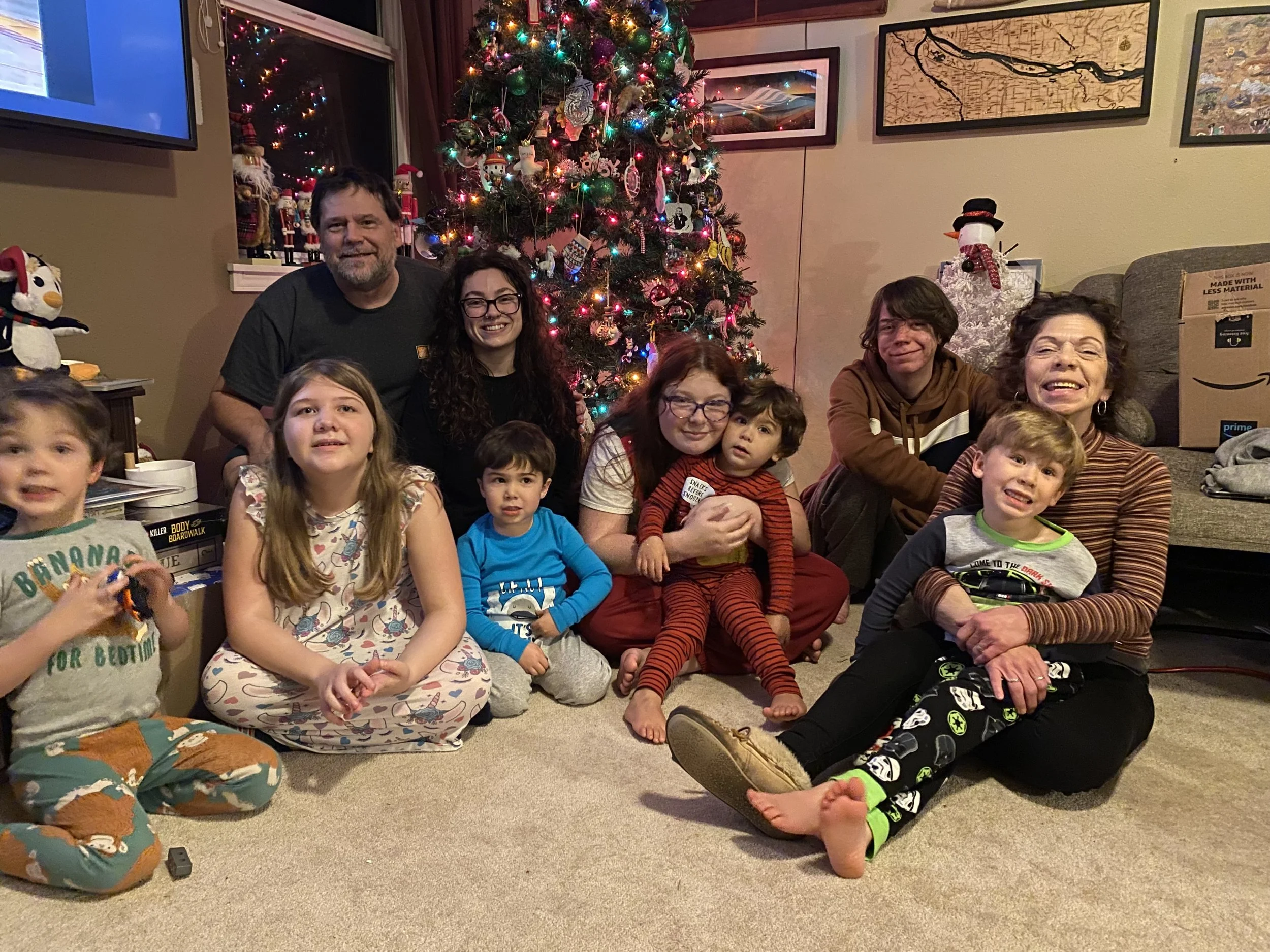
Mary Grace with her beautiful family, Christmas 2021.
